SAAA Game Rules

The Official Rules Governing the Scottish Heavy Highland Athletic Events
Sanctioned by the Scottish American Athletic Association
Revision Date: June, 2015, by Heather MacDonald
Adapted from The Official Rules Governing
the Scottish Highland Games, prepared by Carlos F. Borges
SECTION I: GENERAL EVENT RULES
-
Conduct of the Distance Events – Stone Putt, Weight Throw, and Hammer Toss
- Each competitor shall be allowed three throws in each distance event.
- The competitor may start and stop his/her throw and it will not count as an attempt provided the
implement does not leave the competitor’s hand and the competitor has committed no foul. If the
competitor desires to set the implement down or step out of trig area, they may do so only with the
judge’s permission. - In the stone putt and weight throw the measurement shall be taken from the nearest mark in the
ground made by the stone or the weight, not the handle. In the stones and weight-for-distance events,
the measurement is taken to the center, inside edge of the trig board. In the hammer throw the
measurement shall be made to a point on the inside edge of the trig closest to the center of the
competitor’s stance, to the nearest mark in the ground made by the head of the hammer, not the
handle. - Placing shall be determined by the best legal throw.
- In the event of a tie, placing shall be determined by the next best throw(s).
- In the event of a tie for first place, if the above method does not determine a first place winner then
additional throws shall be made to try to break the tie. If, after a maximum of three additional throws,
there is still no winner then the event shall be declared a tie. - Ties for places other than first, not broken by the next best throw(s) are to be declared ties.
- In the event of a tie, the points for the places shall be added together and divided evenly among
the tied competitors. - At the conclusion of each event, the winner of the event may be given three attempts to try and set
new records. The competitor may use all, some, or none of these extra attempts. The best legal throw
shall be recorded as a new record if the old one has been broken. Extra throws shall not be used in
determining aggregate points with regard to a decathlon scoring system.
-
Configuration of the Throwing Area for the Distance Events
- The trig is to be made of wood. It shall measure 4 feet 6 inches long and 5 ½ to 6 inches high.
Every effort shall be made to secure the trig to the ground so that it will not move during the event if a
competitor steps against it. - All areas beyond the frontline (which includes all parts of the trig except the inside vertical face)
and behind the backline are out of bounds and contact with any of these areas by any part of the
competitor’s body during an attempt shall be a foul and count as an attempt whether the implement
has been delivered or not. - For the stone putt the backline shall be set at 7 feet 6 inches from the trig. For the weight throw the
backline shall be set 9 feet from the trig. No backline is used in the hammer throw. - In the stone putt and weight throw two sideline configurations are allowed:
- The box configuration has sidelines that are perpendicular to the trig and set even with its edges so
that the distance between the sidelines is 4 feet 6 inches. The competitor must start with at least one
foot completely within the sidelines and must finish with at least one foot completely within the
sidelines. It is a foul if two consecutive foot falls contact the ground beyond the sidelines. It is a foul if
any part of the competitor’s body other than the feet contacts the ground beyond the sidelines.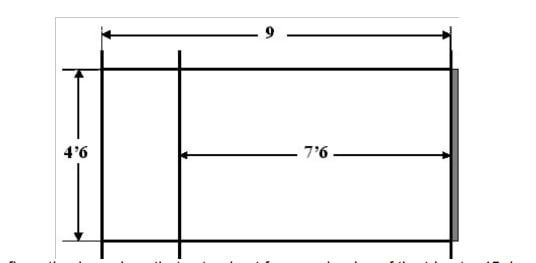
- The wing configuration has wings that extend out from each edge of the trig at a 45 degree angle.
The sidelines then continue perpendicular to the trig all the way to the backline. The sidelines are
parallel and not more than 6 feet 9 inches apart. All areas beyond the sidelines are out of bounds and
contact with any of these areas by any part of the competitor’s body during an attempt shall be a foul
and count as an attempt whether the implement has been delivered or not. The wings may be either
painted lines, or extensions of the trig board itself.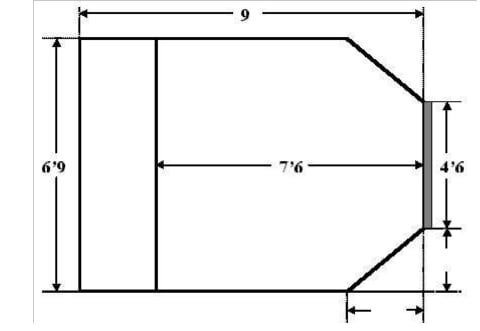
- The box configuration has sidelines that are perpendicular to the trig and set even with its edges so
All measurements for weight for distance and stones events shall be taken from the point at the
center of the inside edge of the trig board.
- In the hammer throw no sidelines are used. The competitor must have at least one foot directly
behind the trig board at all times, but both feet behind the plane of the trig board during the throw and
after the release of the hammer (i.e. one foot must remain within the confines of an imaginary box
configuration). - In all throws, if the implement lands behind the plane of the trig the throw is a foul.
-
Conduct of the Height Events – Weight over the Bar and Sheaf Toss
- Standards similar to those used in the pole vault should be used. Two configurations are allowed:
- Knockoff bar: The crossbar should sit on pins that extend perpendicularly from the uprights; the
crossbar should not be attached to the uprights, so that if the implement hits the bar it will generally
be knocked off. If the implement goes over the bar, the attempt is good whether or not it hits the bar
provided the bar is not knocked off the pins. - Fixed bar: The crossbar is physically attached to the uprights so that if the weight hits the bar it will
remain in position. If the implement goes over the bar, the attempt is good whether or not it hits the
bar.
- Knockoff bar: The crossbar should sit on pins that extend perpendicularly from the uprights; the
- The distance between the uprights should not be less than 10 feet, when possible.
- The judge has full discretion to establish the starting height and all subsequent heights. However, it
is important that all decisions concerning the height of the bar should be made in consultation with the
competitors. - The starting height shall be divisible by 12 inches. The bar should be raised in increments of 1 foot
(2 feet for sheaf) until two or fewer competitors remain, after that the competitors may request any
increment; for example, 1 foot in sheaf or 6 inches in WOB. For record attempts only, the bar may be
set at any height divisible by 1 inch. - All measurements shall be made from the ground to the top of the crossbar at its lowest point.
- The implement must go over the bar within the uprights.
- A competitor shall have the discretion to commence at the starting height or at any subsequent
height. - A competitor may “pass” an attempt at any height; however, a competitor who forgoes an attempt
at a height thereby forfeits the right to attempt again at that height. In addition, once a competitor
begins attempting a height, he/she must complete the attempts at said height. (For example, a
competitor may not fail an attempt at 13’ and request a “pass” at 13’.) Such competitor may, however,
attempt that height if needed to break a tie for first place. - Three consecutive failures, regardless of the height at which such failures occur, disqualifies the
competitor from further attempts except as necessary to break a tie for first place. - The winner shall be the competitor who tosses the weight or sheaf over the highest height. Placing
is then determined by the next highest height and repeated until all places are filled. - In the event of a tie, the competitor with the lowest number of attempts at the height at which the tie
occurs shall be awarded the higher place. - If the tie still remains, the procedure described above is repeated at each successively lower height
until all ties are broken or all previous heights have been considered.
m. If the tie still remains: - If it concerns first place, the competitors tying shall have one more attempt at the current height. If
no decision is reached, the bar shall be lowered (if all have failed) or raised (if two or more have
cleared) by an amount determined by the judge. The tying competitors shall then make one attempt
at each height until the tie is decided. In the process of breaking a tie a pass shall be considered a
missed attempt. The competitors may elect to accept the tie provided all competitors involved in the
tie agree. - If it concerns any other place, the competitors shall be awarded the same place in the competition.
- In the event of a tie, the points for the places shall be added together and then divided evenly
among the tied competitors. - Any passes at heights lower than the final height successfully made by the competitor shall be
considered as made attempts in the determination of final placing. - Where all competitors have failed except one, that competitor is entitled to continue until he has
missed three consecutive attempts. The highest height reached shall be used in determining points
with regard to a decathlon scoring system. - Measurements shall be recorded to the lowest quarter inch in all the events.
- The ground surface on which the competition shall take place shall be as flat as possible.
- If an implement breaks during the throw or while in the air, it shall not count as a throw provided it
was made in accordance with the rules. In the event that the competitor thereby loses balance and
commits a foul, it shall not be charged. - When an implement is broken during a competition, a suitable and equal implement shall be
substituted and the competition continued. If the judge does not feel that a suitable and equal
implement has been substituted, then at the judge’s discretion, the round in which the implement was
broken shall be repeated with the distances originally recorded in that round disregarded. - Metal implements shall be made of a metal not softer than brass, or of a shell of such metal filled
with lead or other material. If a filling is used, it must be inserted in such a manner that it is immovable.
Implements that do not conform to these requirements will be considered illegal for use or for record
consideration. - No device of any kind (e.g. weightlifting straps) that in any way assists a competitor when making a
throw shall be allowed. Only the following are accepted:- The use of tape on the wrist, hand, and fingers is allowed, however the taping together of two or
more fingers is forbidden. Any use of tape to protect the hands and fingers should be cleared with the
judge before the event starts. - The use of gloves is allowed.
- In order to obtain a better grip, competitors may use a suitable substance on their hands (or
gloves) only. In the stone putts, a suitable substance, such as chalk, may also be applied to the neck
area. - The use of toe spikes for the hammer throw is allowed.
- The use of weightlifting belts, knee sleeves, braces, and other supportive gear is allowed.
- The use of tape on the wrist, hand, and fingers is allowed, however the taping together of two or
- A time limit of two minutes shall be applied in each individual attempt in all events. The two
minute time limit shall begin when the judge announces the competitor’s name. In the event that a
competitor follows himself in successive attempts, he/she shall be allowed three minutes.
SECTION II: SPECIFIC EVENT RULES
-
Open Stone Putt
Suggested weights for this event are in the range of 16 to 18 pounds for the Men, and 9 to 11 pounds
for the Women. Because of the nature of the implement considerable variation in the weight is
allowed. The event judge or Athletic Director may substitute, at his discretion, a heavier or lighter
stone, if no suitable stone is available. In the event that a lighter stone is used, and an official record
is in question, the record will not be valid.
- The implement shall be of stone and as close to spherical as possible.
- The stone shall be putt from the shoulder with one hand only.
- At the time the competitor takes a stance to commence a putt, the stone shall touch or be in close
proximity to the neck or chin, and the hand shall not be dropped below this position during the act of
putting. - The stone must not at any time be brought behind the line of the shoulders.
-
Braemar Stone Putt
Suggested weights for this event are in the range of 22 to 24 pounds for the men, and 13 to 16
pounds for the women. Because of the nature of the implement considerable variation in the weight is
allowed. The event judge or Athletic Director may substitute, at his discretion, a heavier or lighter
stone, if no suitable stone is available. In the event that a lighter stone is used, and an official record
is in question, the record will not be valid. The same rules apply as in the open stone putt except that
no approach is allowed; the competitor must make a standing throw. The competitor is allowed to
reverse (switching the feet after releasing the stone). The competitor is also allowed to lift the “lead”
foot (the foot closest to the trig board) so long as no forward motion (otherwise known as an
“approach”) of the body occurs.
-
Weight-for-Distance Throw
Standard weights for these events are 28 and 56 pounds for the Men, and 14 and 28 pounds for the
Women. Masters, Novice, and Lightweight competitors may throw a 42 pound weight instead of a 56
pound weight. Women’s Masters and Women’s Lightweight may throw a 21 pound weight.
- The weight shall be made of metal and consist of a spherical or box weight with a chain and handle
attached. The handle may be a ring, triangle, or a “D” shape. The implement shall not measure more
than 18 inches in overall length from the bottom of the weight to the top of the handle. The official
weight of each implement is the total weight, including the handle. - The competitor may use either hand to throw the weight, but only one hand may be used.
- The competitor may start and stop the throw provided that no part of the implement has made
contact with the ground or the trig board during the aborted attempt. If the implement has made
contact with the ground or the trig board after the attempt was initiated and prior to receiving
permission from the judge, then the attempt will be a foul.
-
Hammer Toss
Standard weights for these events are 16 and 22 pounds for the men, and 12 and 16 pounds for the
women.
- The hammer shall be spherical and made of metal, and the shaft shall be of wood, rattan or plastic.
The implement shall not measure more than 50 inches in overall length from the bottom of the weight
to the top of the handle. The official weight of each implement is the total weight, including the handle. - The hammer shall be thrown in a standing style. Although some movement of the feet prior to the
release is allowed, there shall be no approach and the competitor is not allowed to spin the body. - The competitor in the starting position, prior to the preliminary swing, is permitted to rest the head
of the hammer on the ground on either side of the trig, or on the trig board itself. - It shall not be considered a foul throw if the hammer touches the ground beyond the trig or the trig itself at the beginning of an attempt. After initiating the swings it shall be a foul if any part of the hammer touches the ground beyond the trig, or the trig itself.
-
Weight Over the Bar
Standard weights for this event are 56 pounds for the men, and 28 pounds for the women. Masters,
Novice, and Lightweight competitors may throw a 42 pound weight instead of a 56 pound weight.
Women’s Masters and Women’s Lightweight may throw a 21 pound weight.
- The weight shall be of metal and consist of a spherical or box weight with a triangle, ring, or “D”
handle attached. The implement shall not measure more than 18 inches in overall length from the
bottom of the weight to the top of the handle. The official weight of each implement is the total weight,
including the handle.
b. The competitor may use either hand to toss the weight, but only one hand may be used.
c. Any style may be used to toss the weight as long as it is deemed safe by the judge and/or Athletic
Director.
-
Sheaf Toss
Standard weights for this event are 20 pounds for the men and 10 pounds for the women. Masters,
Lightweights, and Novice will throw a 16 pound sheaf. Because of the nature of the implement some
variation in the weight is allowed.
- The sheaf shall be a burlap bag filled with straw, hay, rope, or other similar material. It is
recommended that two or three bags be put over each other so that the sheaf will last through the
whole competition. The sheaf should be as compact as possible, and are generally constructed in a
“pillow” or “cube” design. - The toss is to be made using a pitchfork with a minimum of 2 tines.
- Any style may be used to toss the sheaf as long as it is deemed safe by the judge.
- Competitors may bring their own pitchforks but it is understood that any competitor may use any
pitchfork that will be used in the competition.
-
Caber
There is no standard size or weight of a caber, but when possible the caber chosen should be able to
be turned by approximately ½ of the class. A challenge caber should be of a length and weight
beyond the power of all but the best competitors to turn. The caber is to be made of wood, although
metal may be substituted when deemed necessary. Both a back judge and a side judge must be used
for the caber, except where a “qualifying caber” is used. Both back and side judges should be
certified judges. The caber shall be placed upright by the stewards in balance, with the heavy end
uppermost, ready for the competitor to make his/her attempt. As soon as the competitor receives the
caber safely and the stewards stand clear, the attempt commences.
The judge may set boundaries if he feels the ground in a certain area is not suitable for the caber to be tossed. Safety should be a
primary concern and the caber should always be at a safe distance from spectators and other
competitors during the toss. The competitor may take any length of run he wishes and may toss the
caber from where he chooses, as long as it is within the judge’s boundaries. If the competitor allows
the caber to fall before lifting it off the ground, this shall count as an attempt. If the competitor drops
the small end of the caber back to the ground after having picked it up, this also counts as an attempt.
Where the ground is uneven a mark should be made from near which, and not beyond which, the
toss shall be made. Under no circumstances shall a fixed trig or stance be used.
The caber must be judged on its landing position, not the position to which it may bounce or roll. The caber must pass
through the vertical position in order to count as a turned caber. The vertical position is 90 degrees
and it is up to the side judge to determine if the caber has passed through the vertical plane.
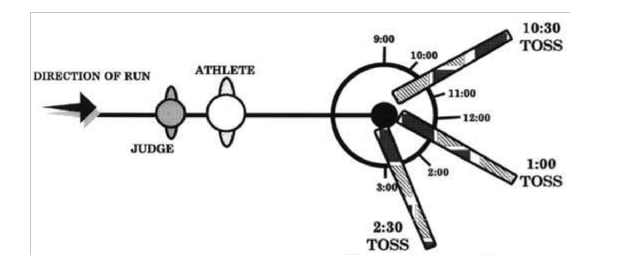
Subsequently, the “clock face method” of judging shall be used.
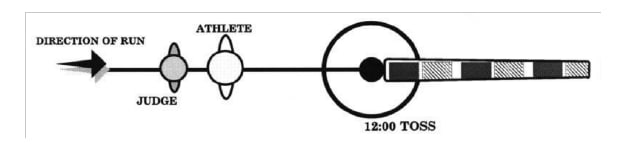
The caber in a perfect toss will pass through the vertical position and land with the small end pointing directly at 12 o’clock in an imaginary
straight line extending from the competitor through the initial landing point and in line with the
direction of the run. An overhead view is drawn below to demonstrate a 12 o’clock toss.
A valid turn is when the small end of the caber passes through the vertical position and falls away
from the competitor to land within the 180 degree radius, between 9 o’clock and 3 o’clock. An
overhead view is drawn below to also demonstrate some turned cabers and how they are scored.
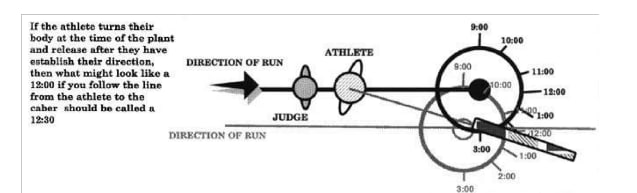
The direction of run is determined by the path taken once the competitor is deemed by the judge to
be in control of the caber (this must be a minimum of three steps). The competitor may run in one
direction and then stop and change direction, as long as they maintain control of the caber. If the
caber lands in a 12 o’clock position pointing away from the competitor but not in a direct line with the
run, then the judge must determine the competitor’s original direction of run and establish where a
true 12 o’clock toss would be. He must then give an appropriate judgment based on the amount of
deviation from the line.
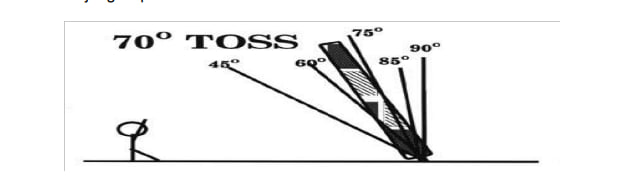
If the competitor does not turn the caber, then it is the responsibility of the side judge to determine the
angle at which the caber was tossed with respect to the 90 degree vertical. The side judge should be
perpendicular to the competitors’ line of approach in order to make an accurate call. A picture of a
view from the side judge’s position is shown below.
Each competitor is allowed three attempts, the best of these to count in the determination of his
placement in the competition. The order of placing shall be determined by the nearest to 12 o’clock
toss made by a competitor. If the competitor did not turn the caber, then placing shall be determined
by the toss closest to the 90 degree vertical.
In the event of a tie, the place shall be determined by the next best attempt(s). If this does not
produce a first place winner one additional attempt by the tied competitors shall be made. If a winner
is not determined by this additional attempt, then the event shall be declared a tie. Ties for places
other than first not broken by the next best attempts shall be declared a tie.
If the caber has not been turned after one complete round, then the judge may cut or substitute the
caber. The caber shall be cut from the large end by an amount determined by the judge. This process
can be repeated until the caber has been turned. If the caber breaks during the competition, placing is
determined by all completed rounds. If fewer than two full rounds have been completed, and a caber
of equal size and difficulty is available then all three rounds of the caber may be repeated. If a
qualifying caber is used, then any successful turn qualifies the competitor for the next caber.
SECTION III: GENERAL RULES OF COMPETITION
- After each completed event, the competitor who threw first is now placed last in the next event and
everybody moves up one place. This is repeated after every event. - The one-point scoring system is recommended. In this system a competitor receives points
depending on placing in each contested event, one point for a first place finish, two points for second
place, and so on. The competitor with the fewest accumulated points after all of the events have been
contested is the overall games winner. If there is a tie for first overall then the winner shall be the
competitor with the most first places in the individual events. If this does not produce a winner, then
the competitors remain tied. Other scoring systems (e.g. decathlon scoring) may be used provided
that the competitors are informed of the scoring method to be used before the start of the competition. - A competitor must make at least one attempt in every event in order to place in an overall
competition. - In the interest of safety, the judge has the right to disqualify any competitor who, in the judge’s
opinion, does not have the ability to complete a throw without undue risk of injury to himself, other
competitors, or spectators. The judge also has the right to disqualify any competitor who displays
poor sportsmanship or engages in inappropriate conduct. - Many games include local “challenge” events or use local rules as a matter of tradition (e.g. 100#
Braemar stone putt). It is the responsibility of the Athletic Director to announce any local events of
rules in writing well in advance of the games. - The field judge in conjunction with the Athletic Director of a game may make on the spot rules
variations to accommodate the participation of disabled athletes. All such changes should be made
with safety as the preeminent concern. - The Athletic Director of a game may establish objective classes for that game. Some examples
include Masters, Lightweight, Novice, etc. - Lightweight competitors will weigh in at less than 200 pounds on the day of competition. Women’s
lightweight will weigh in at less than 150 pounds on the day of competition. - The Athletic Director reserves the right to limit on-field (“walk-on”) registrations, and to limit class
sizes in order to ensure the safety of competitors and spectators. - In the event that a World Record is broken, it is recommended that a steel tape be used to
accurately determine the distance or height of the toss. It is also recommended that a second judge
witness the measurement, and that the implement used to break the record be measured and
weighed using a certified postal scale. If the implement is not verified as legal, the record is not
considered valid.
SAAA Field Liability Waiver
Completion of this waiver is a requirement for participating in Highlands Athletics with the SAAA.
If you have not yet – please print and sign the linked .PSD below and bring it with you on game day.
Download SAAA Liability Waiver
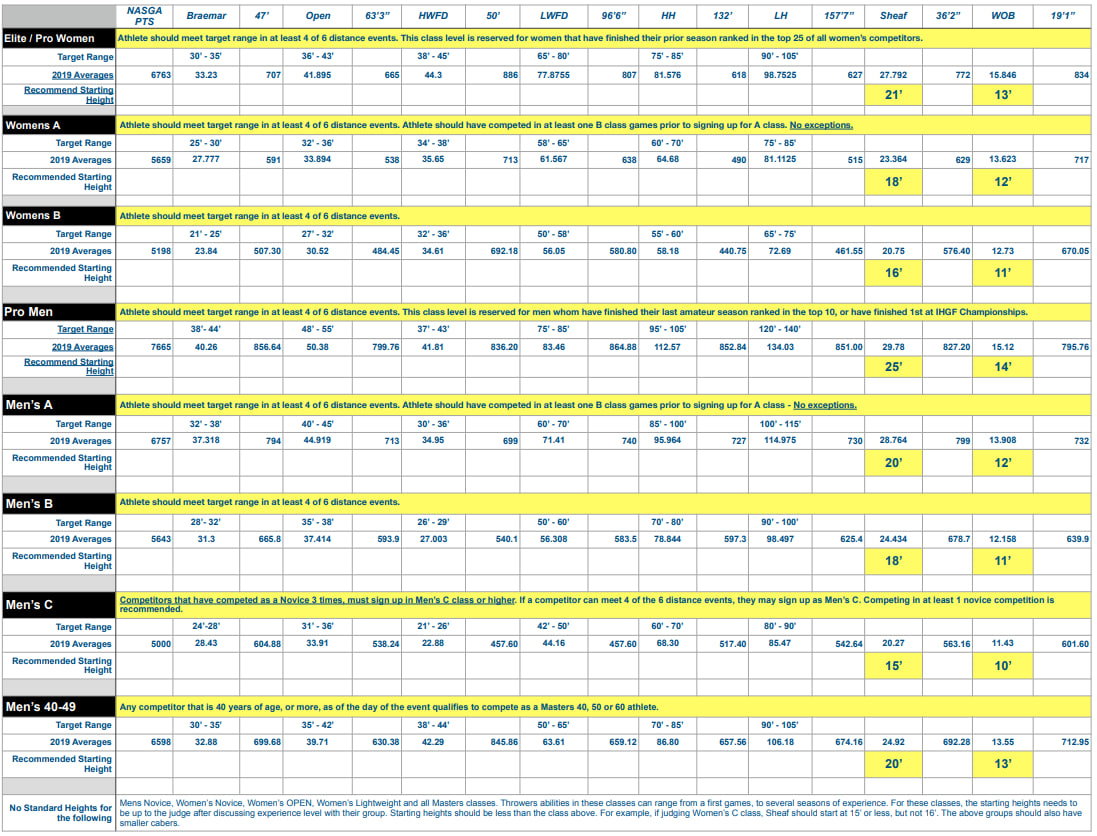
Athlete Class Guidelines
Drug Testing Policies
SAAA Drug Testing Procedures and Appeals Rules
Every athlete, in every class agrees to compete under the current rules and procedures of the
SAAA, as stated in the most current revision of our rules https://www.saaa-national.org/
information).
These rules include drug testing for performance enhancing drugs. For a list of all banned
substances, please see the list of “Prohibited at all times” on the World Anti-Doping agency(WADA) website https://www.wada-ama.org/en/content/what-is-prohibited/prohibited-at-alltimes/anabolic-agents
WHEN WILL ATHLETES BE TESTED?
As an athlete participating at an SAAA highland games competition, athlete agrees to both
random drug testing and automatic testing for any new World Record. Random testing will be
done at the discretion of the Athletic Director.
HOW WILL THE TEST BE ADMINISTERED?
Athletes will be tested, with two representatives present. Typically, this would be one
representative of the SAAA, and one representative of the IHGF. A urine sample will be taken
upon request, and submitted to a local testing laboratory. The athlete will be required to lower
clothing to their knees and raise all shirts to only cover their chest. The athlete will sign the
sample to ensure it is authentic and their own.
WHAT IF THE ATHLETE REFUSES TO BE TESTED?
Refusal to accept a required test will count as a failed test. Refusal to accept any of the rules of
testing or SAAA procedures will also result in a failed test. Visual confirmation by SAAA officials
of a “whizzinator” or similar device used to falsify sample specimens, will result in a failed test.
EXCEPTIONS AND APPEALS
If an athlete tests positive for a banned substance, but that athlete can produce a prescription
for legal use of the substance, and the substance is listed as legal for that state at the time of
testing, an exception will be made for the athlete. If the athlete tests positive for other banned
substances, without a prescription, or the substance is listed as a controlled substance, like
Trenbolone (Schedule III controlled substance), no exceptions will be made for these instances.
In the event an athlete tests positive, they may appeal the test with proof of an existing legal
prescription, or with a blood and urine test, done at a third party testing facility that is accepted
by the SAAA, within 10 days of the positive SAAA test result. All appealed tests will be paid for
by the appealing athlete. Results shall be provided in full to the Athletic Director of the event.
All appeals will be voted on by the SAAA board to determine if penalties will be enforced, or
not.
PENALTIES
Any athlete that tests positive will receive a two (2) year ban from all SAAA highland games
events. If an athlete fails a second test, they will receive a four (4) year ban and after a third (3)
failed test, they will be banned from all competitions for life.